

Grief has a way of showing up in the ordinary places: the other side of the bed, the chair at the head of the table, the phone contact you can't bring yourself to delete, the milestones that keep arriving without them. When you're looking for a memorial gift for someone who has lost a husband, a father, a brother, a sister, or a son — or for yourself — the intention is the same across every relationship: to honor who they were, not just the fact that they're gone.
This guide covers gift ideas that tend to resonate, organized by relationship, because the details that make a gift feel true to a person differ depending on who you lost. A generic "In Loving Memory" keepsake responds to the idea of a loss. What actually lands is specificity.
Why Personalized Gifts Matter More Than Generic Sympathy Products
A relationship is built out of specifics — inside jokes, a particular laugh, the way someone made coffee, a nickname only they used. That's exactly what mass-produced sympathy products can't reach. They respond to the category of loss, not to the actual person.
A meaningful memorial gift tends to share a few qualities regardless of relationship:
- It references the person specifically — their face, their handwriting, their voice in a video, a phrase only they said — not a generic "beloved" placeholder
- It's made with intention — not assembled in five minutes and drop-shipped
- It lasts — something to return to across years, not something that fades after a week
With that framework in mind, here's what tends to matter most for each relationship, followed by the gift categories that work across all of them.
For the Loss of a Husband
Losing a husband reshapes the most ordinary parts of a day — the other side of the bed, the news you turn to share and then remember there's no one to tell. For a widow, and for the children and friends who loved him, the absence isn't loud. It's in the small, constant places.
Gifts that resonate here tend to lean on the specifics of a shared life: his wedding ring worn on a chain or joined with hers, a handwriting piece made from a card he signed, a photo book that traces the years from when you met. Widows we've talked to describe the gifts that mattered most as the ones that acknowledged the marriage itself, not just the loss — a book of "our life together," a bench where he used to sit with his coffee, a photo completed with him standing where he should have been for a milestone he didn't live to see.
"My husband passed the year before our daughter's wedding. He always said he'd walk her down the aisle. We took a portrait of him from our anniversary and had it composited into the family photo from her wedding day — him standing right next to her. She keeps it on her nightstand." — Linda R., wife
For the Loss of a Brother
A sibling bond is built out of shared history — the house you grew up in, the parents you both navigated, the private language of a childhood. Losing a brother means losing the person who knew that history from the inside, whether he was older or younger, the one you'd call about the game or count on to remember things exactly the way you did.
What tends to matter for a brother's memory is anything that captures the shorthand only he understood: a keychain made from his handwriting on a note ("gone fishing, back by 6"), a book of the adventures rather than a polished chronology, a bench at the trailhead he hiked every weekend. The goal isn't a formal tribute. It's something that sounds like him.
"I carry a keychain made from his handwriting — a note he left on my car years ago, just 'gone fishing, back by 6.' It's the most him thing I own." — Brother
For the Loss of a Sister
Losing a sister means losing the person who knew you before almost anyone else did — the one who could finish your sentences, the friend you didn't choose but couldn't imagine life without. The absence shows up in the jokes no one else gets and the family gatherings that feel uneven now.
Gifts for this loss tend to work best when they capture a specific, shared texture: matching bracelets with her initials that siblings wear without needing to say anything about it, her favorite flowers planted where the family gathers so the yard smells like her every spring, a photo book of just the two of you rather than the whole extended family. A photo composite that finally includes her in a moment she missed — a niece she never got to hold, a wedding she didn't live to see — tends to be the gift families describe as the one they didn't know they needed.
"My sister died before my son was born. She'd been so excited to be an aunt. We had one beautiful photo of her, and we had it composited into our first family portrait — her holding him. My mom couldn't speak. It's the photo I wish had been real." — Megan S., sister
For the Loss of a Son
Losing a son disrupts the natural order of things, and the grief doesn't follow a schedule. For parents, siblings, and friends, the absence shows up everywhere: the empty chair, the phone contact that stays in the list, the milestones that keep arriving without him.
What tends to help here is anything built from contributions of the people who knew him at different points in his life — friends, teammates, coworkers, roommates — because no single person holds the whole picture. A shared photo album pulled together from his college friends, a fingerprint pendant his mother wears every day, a portrait from a graduation his parents keep in the living room. Photo composites carry particular weight for parents who are missing a specific, unmeetable moment: a niece he never held, a wedding that happened after he was gone.
"My son never got to meet his niece. We had one good portrait of him from a few years before. When I saw the composite — him holding her, in that backyard — I called my daughter and couldn't speak for a minute." — Karen M., mother
For the Loss of a Father
Losing a father reshapes the ground you stand on. Whether it comes suddenly or after a long illness, the absence shows up in ordinary places — the chair at the head of the table, the advice you reach for and can't get, the milestones that arrive without him there to see them. Sons and daughters are often expected to stay composed and hold the family together, which can make this grief particularly quiet.
Because this loss touches so many people at once — a spouse, children, grandchildren, siblings — gifts that gather contributions from multiple people tend to land especially well: a memory book with photos and stories from siblings, old friends, colleagues, and grandchildren; a workshop or tool keepsake for a father who built or fixed things; a maple planted where he used to park his truck. A father's watch, restored and worn again, is one of the most common keepsakes for a reason — it's something that was genuinely his, still functioning, still present.
"My dad died eight months before my wedding. We had one good portrait of him from my sister's graduation. When I saw the composite — him standing next to me in my dress, in the garden where we got married — I couldn't speak. That's the photo on our mantel now." — Rachel T., daughter
If the loss is of a mother rather than a father, we've written that guide separately: personalized memorial gifts for loss of mother covers the same ground with context adjusted for that relationship.
Photo Composites: Adding Them to the Moments They Never Got To Be In
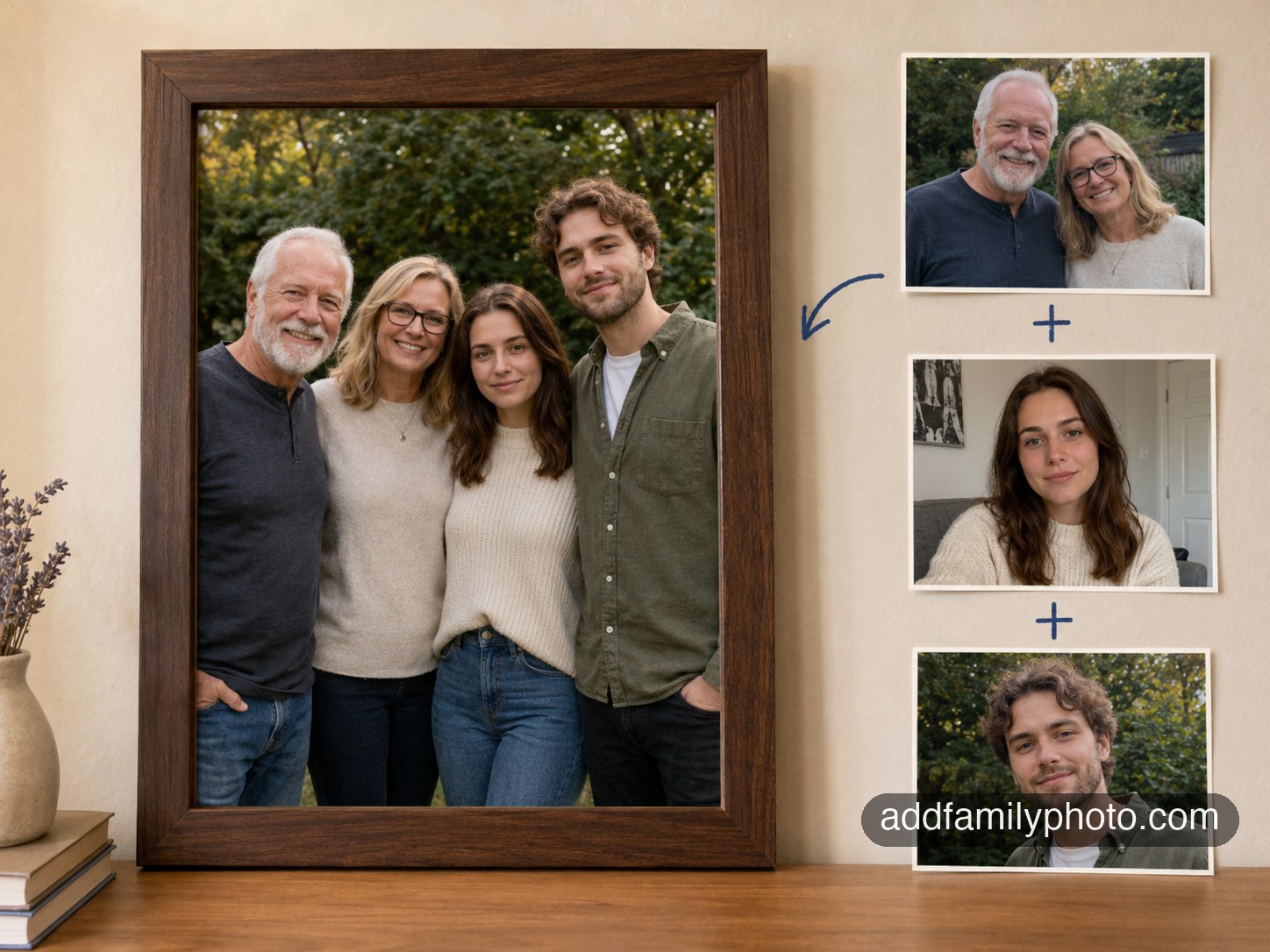
Across every relationship above, one gift comes up again and again: a photograph that should have included them, made whole. A wedding they didn't live to attend. A grandchild or niece or nephew they never got to meet. A family reunion or graduation with a visible gap where they should have stood. Modern AI can place a person into those scenes naturally, with attention to lighting, composition, and how they actually looked — not as digital manipulation for its own sake, but as a way of having a photograph that reflects what the moment meant to the family, even when the timing of the actual day was different.
The concern about whether this is respectful is understandable, but the response from most families is the opposite of what you might expect. The reaction tends to be recognition — that's them, in that moment — rather than discomfort. Victorian families regularly commissioned post-mortem photographs and portraits; placing a loved one into a meaningful photograph sits in that same tradition. The key is that the result looks natural and true to who they were.
At AddFamilyPhoto, you can upload a family photo and a portrait of the person you've lost, and see a free preview in under 60 seconds — no account or payment required. Single photos start at $19 (4 high-resolution variants); Family plans at $49 give you 5 run credits for multiple photos or moments.
See a free preview — no account needed →
Other Memorial Gift Categories Worth Considering
Custom Portraits and Memorial Art
A painted or illustrated portrait — drawn from a photograph, rendered by an artist — is something a family keeps differently than a print. It occupies space in the home in a way that feels like presence rather than documentation. A commissioned oil or watercolor portrait from Etsy or a local artist typically runs $200–$800; a softer illustrated portrait (watercolor, pencil, or digital) is often $80–$200.
Engraved Jewelry and Keepsakes
Wearing or carrying something of theirs — or something that names them — is a way of keeping a person close. Handwriting pieces (companies like Wear My Words transfer actual handwriting onto a pendant or dog tag, $60–$180), fingerprint pendants ($100–$300), and simple bar necklaces with a name or significant date ($40–$120) all fall in this category. For a husband, his wedding ring reworked or joined with the widow's own is a especially common choice.
Memorial Books and Photo Albums
A curated photo book is something a family returns to over years, not weeks. The key is curation, not volume: a sequence that tells something true about who the person was, rather than a random assortment of photos. Services like Artifact Uprising or Chatbooks produce print-quality books from digital photos ($60–$150). A memory book with contributions from many people — friends, coworkers, siblings, teammates — takes more coordination but produces something no single person could assemble alone.
Garden and Outdoor Memorials
For families with outdoor spaces, a physical place to mark the loss acknowledges that grief continues; it's not a one-time gesture but something that changes with the seasons. Options range from an engraved garden stone ($40–$120) to a memorial tree ($50–$200) to a memorial bench for a favorite park or trail ($300–$600+).
Digital Memorials and Online Tributes
Not every meaningful memorial is physical. For families spread across distance, a private memorial website (through services like Ever Loved or GatheringUs) lets people share photos, stories, and condolences, often free at basic tiers. A video tribute compiling photos and short clips — something families return to on anniversaries and birthdays — typically costs $150–$400 through a local videographer.
Choosing the Right Memorial Gift: A Practical Guide
How much should I spend on a memorial gift?
There's no correct number. What matters more than cost is effort — a gift that required thought and care lands differently than an expensive but generic one. Photo composites at AddFamilyPhoto start at $19 for a single run (4 high-resolution variants). Custom portrait commissions typically run $150–$400. For most people, $50–$150 is a reasonable range for a meaningful memorial gift.
How long after a loss is it appropriate to give a memorial gift?
There's no wrong time. The immediate aftermath is when most gifts arrive and when they can get lost in the fog. Many families find that a gift given weeks or months later — when the acute support has faded and the house is quiet — is the one they remember most. Anniversaries, birthdays, and significant milestones the person would have attended or witnessed are all meaningful moments to acknowledge.
What if the relationship was complicated?
Many are, and grief after a complicated relationship is its own kind of hard. A memorial gift doesn't have to declare a closeness that wasn't there. Something honest — a single photograph made whole, a keepsake marking a shared date, a quiet contribution to a cause they cared about — can hold a complicated relationship without overstating it. The goal isn't to rewrite the story; it's to acknowledge that they were part of yours.
Can a memorial gift help with grief?
A gift won't shorten grief, and it shouldn't try to. What a good memorial gift does is say: they were here, they were known, they are not forgotten. That tends to matter more than any comfort product promising to help someone "heal."
If there's a photograph that would mean the world to complete — one where they should have been, but weren't — AddFamilyPhoto offers a free preview. Upload the family photo and a portrait of your loved one, and see the result in under 60 seconds. No account required.
For more on honoring those who are no longer here, see the guide to adding a deceased loved one to family photos and the memorial gifts guide for loss of mother.